
Beehiiv Review : The Verdict (Read This First)
beehiiv is the strongest newsletter platform for creators who plan to monetize through paid subscriptions. The 0% platform take on paid subscriber revenue is real, and it saves serious money once you scale — at $5,000/mo in subscription revenue, you keep roughly $404/mo more than on Substack.
But beehiiv is not for everyone. The free plan caps at 2,500 subscribers with zero monetization tools, and the jump to paid is steep: $89/mo when you outgrow 2,500 subs, with no middle step. If you need automations and you are under 2,500 subscribers, Kit gives you that free up to 10,000.
Use beehiiv if you are building a newsletter you plan to monetize through paid subscriptions, ads, or Boosts — and you can handle the pricing cliff when you outgrow the free plan.
Skip beehiiv if you need marketing automation on a budget, you run an e-commerce business, or you are between 2,500 and 5,000 subscribers with no revenue yet.
What beehiiv Actually Is (and Is Not)
beehiiv is a newsletter platform, not an email marketing tool. That distinction matters because it explains both what it does well and where it falls short.
What you get is a publishing platform with a built-in website, email sending engine, audience growth tools like recommendations, referral programs, and Boosts, plus a monetization layer covering paid subscriptions, an ad network, and digital products. Everything is built around one use case: recurring newsletters.
What you do not get is marketing automation beyond basic sequences, transactional email, SMS, deep CRM features, or a native Shopify integration. If you need those, beehiiv is the wrong category entirely. Look at ActiveCampaign, GetResponse, or Mailchimp instead.
beehiiv was built by former Morning Brew employees, and it shows. The growth tools — particularly the Boosts marketplace where you get paid to recommend other newsletters, and the native ad network that sells ads on your behalf — are more publisher-focused than anything else at this price point.
The Free Plan: What You Actually Get
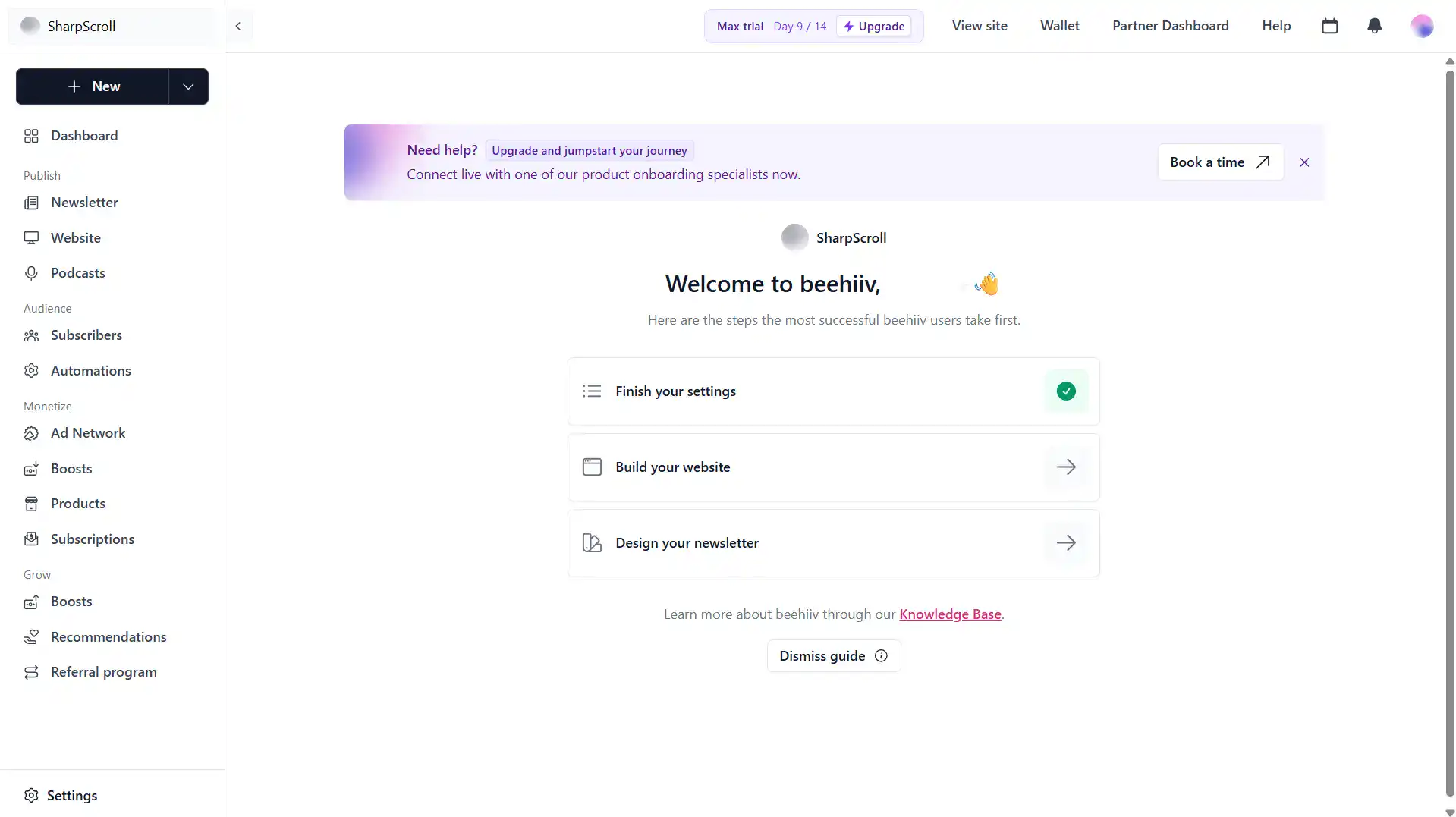
beehiiv’s Launch plan is free forever with no credit card required. We signed up for a fresh account to see exactly what the free plan includes — and more importantly, what it locks out.
What is included free
The free Launch plan is genuinely generous for what it offers: up to 2,500 subscribers, unlimited email sends with no daily or monthly cap, custom domain connection, a website builder with landing pages, basic campaign analytics, the Recommendation Network for mutual newsletter cross-promotion, audience segments, API access, a Link-in-Bio page, up to 3 publications, and 10 AI credits per day.
Unlimited sends alone puts beehiiv ahead of most competitors at the free tier. MailerLite caps free sends at 12,000 per month, and Kit’s free plan limits you to a single email sequence.
What is locked on the free plan
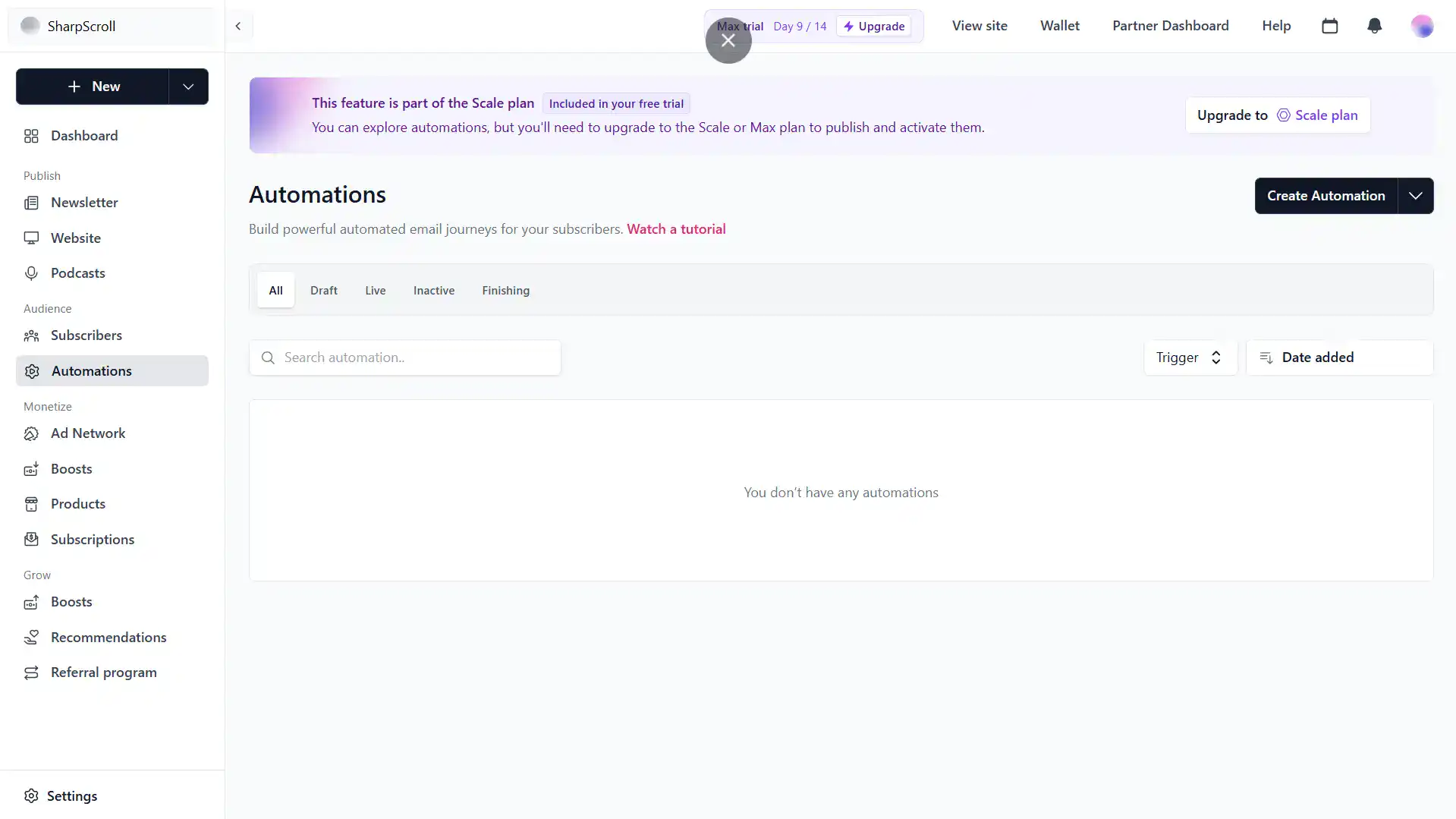
This is where the free plan shows its limits. There is no monetization at all — no paid subscriptions, no ad network, no Boosts, no digital products. You cannot make a single dollar through beehiiv’s built-in tools on the free plan.
Beyond monetization, you also miss out on email automations (not even a basic welcome drip beyond the initial email), A/B testing for subject lines, surveys and polls, the referral program, and advanced analytics. You are stuck with one team member, basic analytics only, and “Powered by beehiiv” branding on your website and every email you send.
The biggest gap is automations. Kit’s free plan includes one automation and one email sequence at no cost — a meaningful edge for creators who want welcome sequences without paying.
beehiiv Pricing: The Real Cost at Every Stage
Most beehiiv reviews say “starting at $43/mo” and move on. The actual cost depends on your subscriber count, your billing cycle, and whether you run paid subscriptions. We verified every tier directly from beehiiv.com/pricing on June 16, 2026.
Platform cost by subscriber count
| Subscribers | Launch | Scale (annual) | Scale (monthly) | Max (annual) | Max (monthly) |
|---|---|---|---|---|---|
| ≤ 2,500 | $0 | — | — | — | — |
| 1,000 | — | $43 | $49 | $96 | $109 |
| 2,500 | — | $61 | $69 | $131 | $149 |
| 5,000 | — | $78 | $89 | $149 | $169 |
| 10,000 | — | $96 | $109 | $193 | $219 |
| 25,000 | — | $149 | $169 | $254 | $289 |
Source: beehiiv.com/pricing · Verified June 16, 2026. See the SharpScroll Pricing Tracker for live comparisons across 15+ tools.
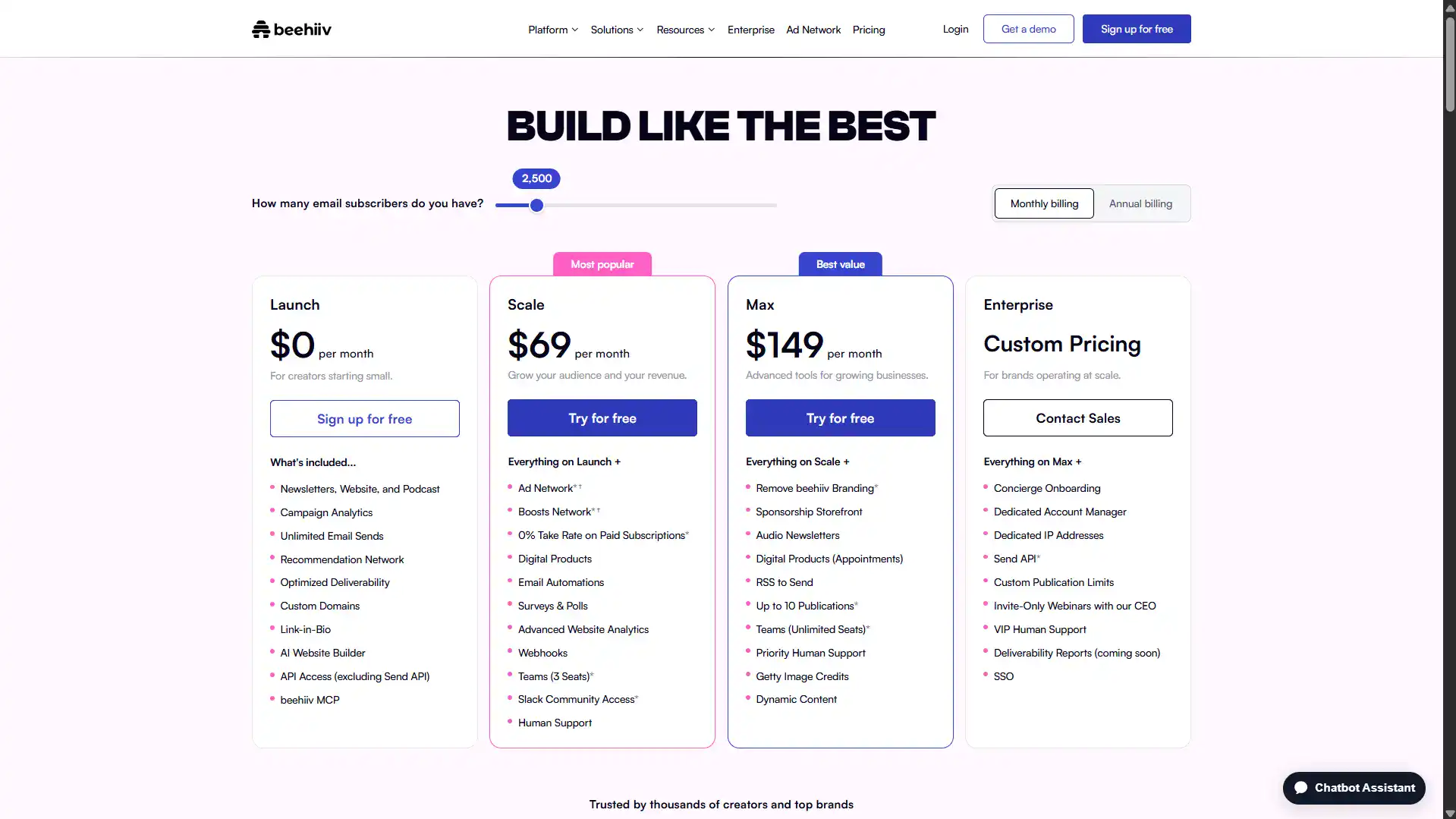
The $0 to $89 cliff nobody warns you about
This is beehiiv’s sharpest edge. You go from paying nothing to $89/mo (or $78 on annual billing) the moment you hit 2,501 subscribers. There is no $10 or $20 middle step, and the jump lands you in the 5,000-subscriber tier — not the 2,500 tier.
For context: Kit lets you stay free up to 10,000 subscribers, though the free plan has other limits. MailerLite offers paid plans starting at roughly $18/mo for 2,500 subscribers with automations included. Buttondown starts at $9/mo for 1,000 subscribers.
If you are growing steadily but not monetizing yet, that $89/mo jump at 2,501 subscribers is real money for zero additional revenue. This is the single biggest reason some creators choose Kit over beehiiv in the early stages.
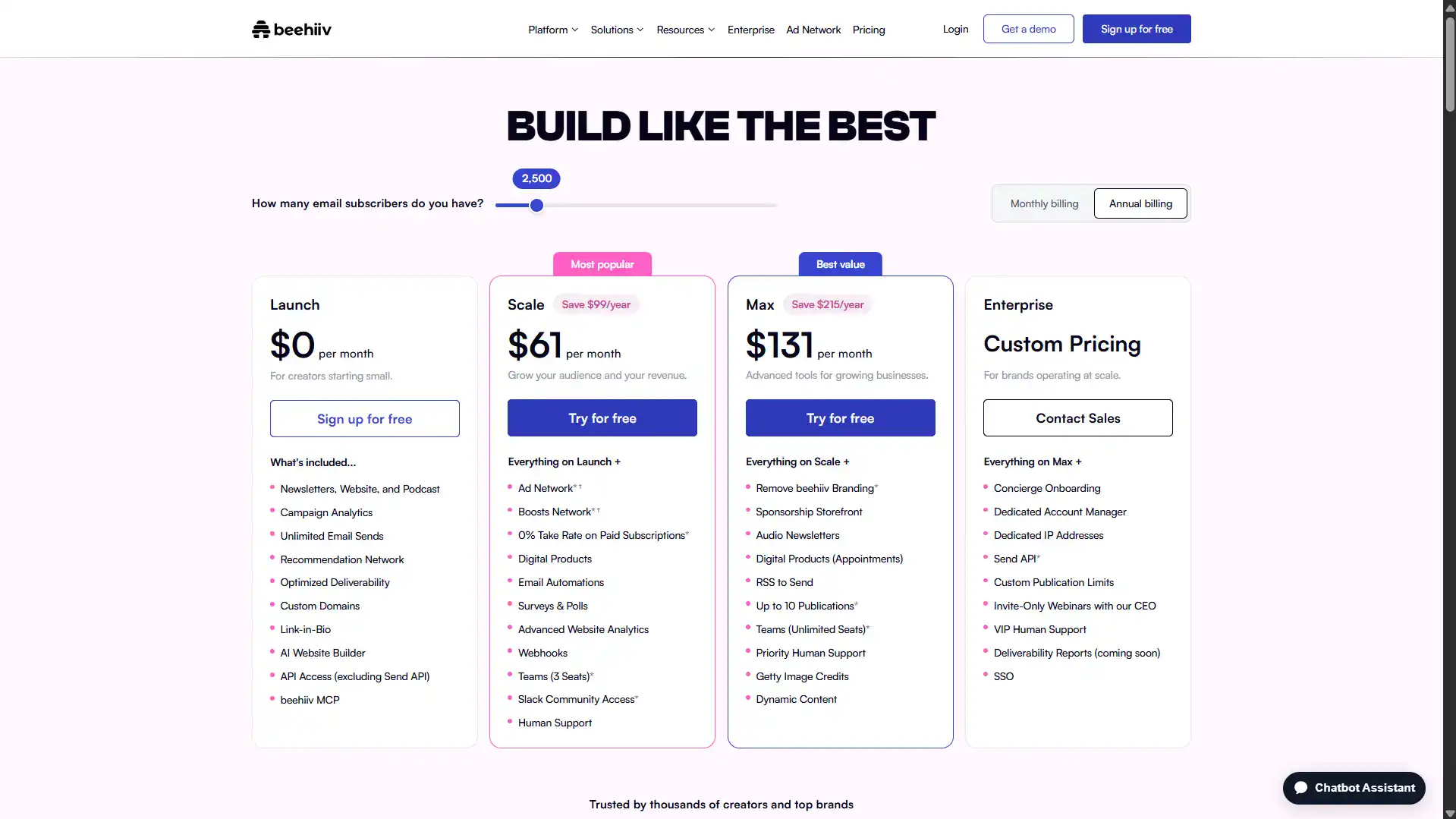
What you actually keep: paid newsletter revenue after all fees
beehiiv advertises a “0% take rate on paid subscriptions.” That is true — beehiiv takes nothing from your subscription revenue. But Stripe still charges 2.9% + $0.30 per transaction, and that adds up. Here is what you actually keep at different revenue levels with a $10/mo subscription price.
At $500/mo revenue (50 paid subscribers)
| Platform | Platform fee | Transaction fees | You keep |
|---|---|---|---|
| beehiiv Scale (5K tier, annual) | $78/mo | $29.50 | $392.50 |
| Substack | $50 (10% cut) | $29.50 | $420.50 |
| Kit Creator (1K tier) | $39/mo | $32.50 | $428.50 |
At $500/mo, beehiiv is actually the most expensive option. Substack’s 10% cut ($50) and Kit’s blended fees are both lower than beehiiv’s $78/mo platform fee at this revenue level. This surprises most people who hear “0% commission” and assume beehiiv is cheapest from day one.
At $1,000/mo revenue (100 paid subscribers)
| Platform | Platform fee | Transaction fees | You keep |
|---|---|---|---|
| beehiiv Scale (5K tier, annual) | $78/mo | $59 | $863 |
| Substack | $100 (10%) | $59 | $841 |
| Kit Creator (1K tier) | $39/mo | $65 | $896 |
At $1,000/mo, beehiiv pulls ahead of Substack but Kit still edges both out. That reverses at higher revenue because Kit’s 3.5% + $0.30 per transaction compounds faster than beehiiv’s flat platform fee.
At $5,000/mo revenue (500 paid subscribers)
| Platform | Platform fee | Transaction fees | You keep |
|---|---|---|---|
| beehiiv Scale (10K tier, annual) | $96/mo | $295 | $4,609 |
| Substack | $500 (10%) | $295 | $4,205 |
| Kit Creator (10K tier) | $119/mo | $325 | $4,556 |
At $5,000/mo, beehiiv saves you $404/mo over Substack — nearly $4,850 per year. This is where the 0% take rate genuinely pays off. Kit remains competitive but the gap widens as revenue grows.
The breakeven point: beehiiv becomes cheaper than Substack once your paid subscription revenue passes roughly $800 to $900/mo. Below that, Substack’s “free until you earn” model actually costs less.
Note: Kit fees assume Creator plan pricing at the relevant subscriber tier. Kit charges 3.5% + $0.30 per transaction on all commerce. Stripe processing fees estimated at standard US rates (2.9% + $0.30). Actual fees vary by country and payment method. See the SharpScroll Pricing Tracker for current verified rates across all platforms.
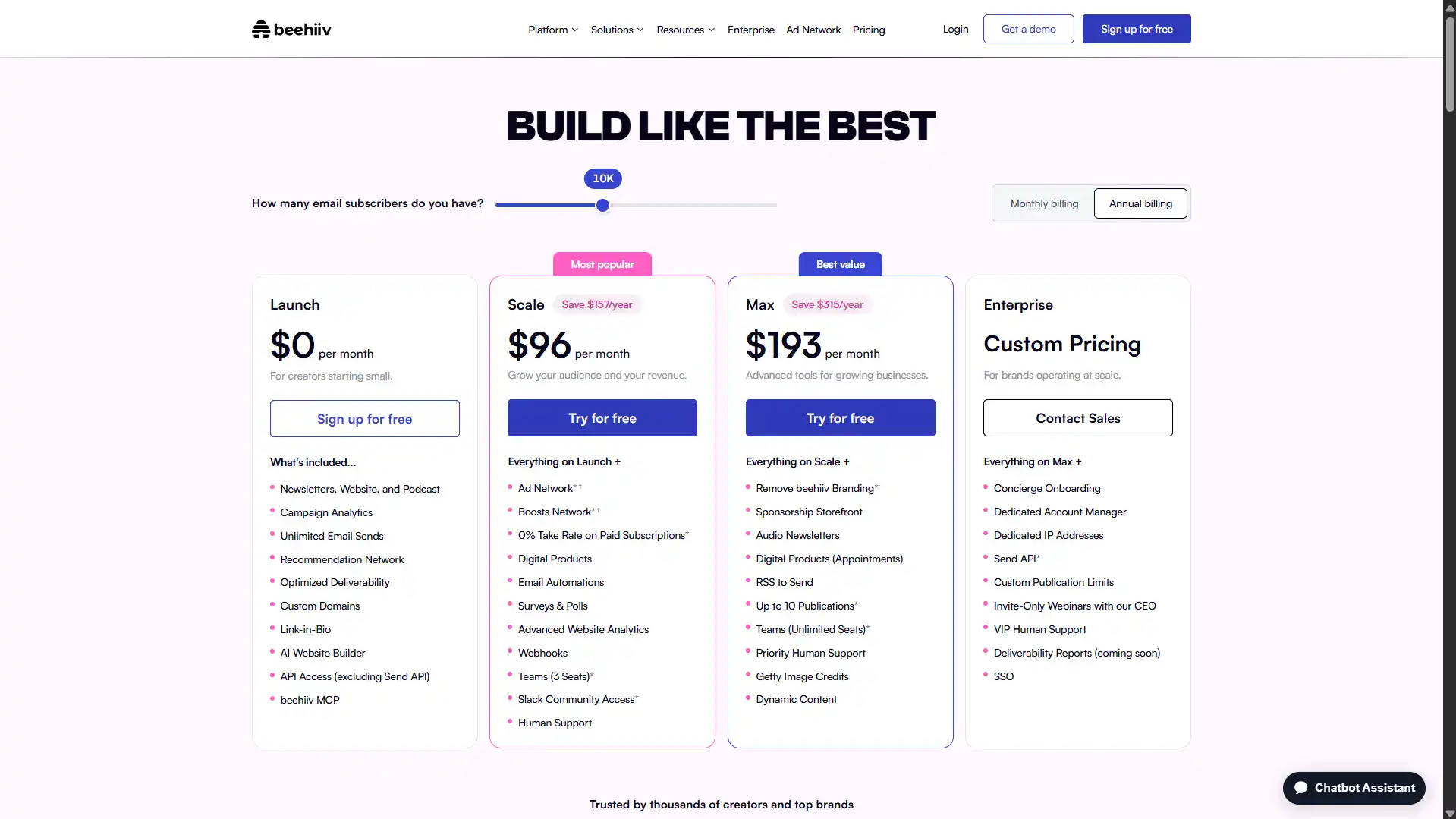
What Is Locked Behind Paid Plans
Here is a quick-reference table showing which features require Scale or Max. The pattern is straightforward: Launch is for testing, Scale is for making money, and Max is for removing branding and running a team.
| Feature | Launch (Free) | Scale ($43+) | Max ($96+) |
|---|---|---|---|
| Subscriber limit | 2,500 | 100,000 | 100,000 |
| Email sends | Unlimited | Unlimited | Unlimited |
| Paid subscriptions | ✗ | ✓ (0% take) | ✓ (0% take) |
| Ad Network | ✗ | ✓ | ✓ |
| Boosts | ✗ | ✓ | ✓ |
| Digital products | ✗ | ✓ | ✓ |
| Email automations | ✗ | ✓ | ✓ |
| A/B testing | ✗ | ✓ | ✓ |
| Surveys and polls | ✗ | ✓ | ✓ |
| Referral program | ✗ | ✓ | ✓ |
| AI credits per day | 10 | 25 | 50 |
| Team members | 1 | 3 | Unlimited |
| Publications | 3 | 3 | 10 |
| Remove branding | ✗ | ✗ | ✓ |
| Priority support | ✗ | ✗ | ✓ |
| Sponsorship storefront | ✗ | ✗ | ✓ |
The Branding Tax: What It Costs to Remove “Powered by beehiiv”
Every email and webpage on the free and Scale plans carries a “Powered by beehiiv” badge in the footer. Removing it requires the Max plan, which starts at $96/mo on annual billing and climbs to $219/mo at 10,000 subscribers.
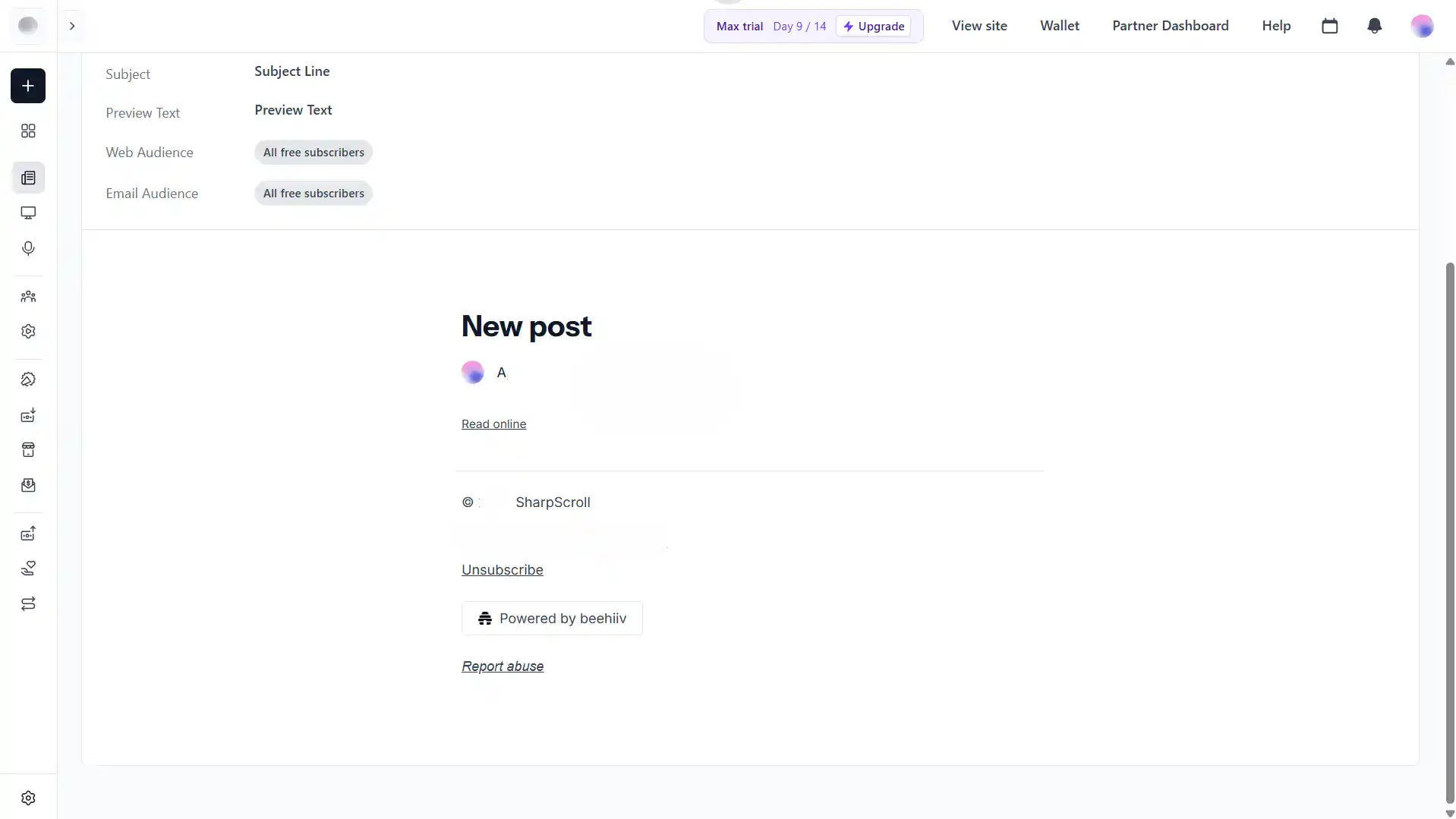
At 1,000 subscribers, upgrading from Scale to Max costs $53/mo extra on annual billing — just for a footer toggle and a few extras like unlimited team seats and audio newsletters. At 10,000 subscribers, the Max premium over Scale is $97/mo.
For most solo creators under 5,000 subscribers, this is not worth it. When it is worth it: if you are selling newsletter sponsorships to brands. Sponsors want their ad next to your brand, not beehiiv’s logo. A white-label newsletter can justify higher CPMs, and if sponsorship revenue exceeds the Max-to-Scale premium, the math works out.
Strengths
0% take rate on paid subscriptions. This is the headline differentiator. No other major newsletter platform matches it — Substack takes 10%, Kit charges 3.5% + $0.30 per transaction. At scale, this saves thousands per year.
Built-in monetization ecosystem. The Boosts marketplace pays you to recommend other newsletters. The native ad network finds advertisers for you. These are passive revenue streams that simply do not exist on Kit or Substack.
Recommendation network. Mutual newsletter cross-promotion is built into the free plan and works from day one. It is the most effective free growth tool for small newsletters — you recommend others, they recommend you back.
Unlimited sends on all plans. Including the free plan. No send caps, no overage charges, no throttling.
Strong deliverability reputation. beehiiv invests heavily in sending infrastructure. Independent tests and user reports consistently rate it among the best for inbox placement.
Clean, focused editor. Purpose-built for newsletters, not adapted from a general email marketing tool. The writing experience feels closer to a CMS than a marketing platform.
Weaknesses
The $0 to $89 pricing cliff. No gradual step between free and paid. When you outgrow 2,500 subscribers, you land in the 5,000-subscriber tier at $89/mo (monthly) or $78/mo (annual). Creators not monetizing yet get hit hardest.
No automations on the free plan. Not even a basic drip sequence. Kit’s free plan includes one automation and one email sequence — a meaningful advantage for creators who want welcome sequences without paying.
Thin integrations. beehiiv’s integration library is small compared to Mailchimp, Kit, or ActiveCampaign. No native Shopify connection, no deep CRM sync. Zapier fills some gaps but adds cost.
No SMS or transactional email. Not available on any plan. If you need order confirmations or SMS campaigns, you need a separate tool.
AI credits are rationed. 10 per day on the free plan, 25 on Scale, 50 on Max. Heavy users will hit the ceiling.
Branding removal is expensive. Requires the Max plan starting at $96/mo on annual billing. At 10,000 subscribers, that is $219/mo monthly — a $110 premium over Scale just to remove a footer badge and unlock a few extras.
PayPal-only affiliate payouts. The partner program pays commissions only through PayPal. No direct bank transfer or Stripe payout option is available.
Who Should Use beehiiv
beehiiv is the right choice if you are building a newsletter-first business and plan to monetize through paid subscriptions, the ad network, or Boosts. The 0% take rate on paid subscriptions is unmatched, and the built-in growth tools make it the most complete newsletter-as-a-business platform available today.
It is especially strong if you expect to cross 2,500 subscribers and have monetization revenue to offset the Scale plan cost, if you want built-in monetization without stitching together separate tools, if you value deliverability and a clean newsletter-focused editor, or if you want passive revenue options like Boosts and the ad network alongside your main content.
The free plan is also a solid way to test a newsletter idea at zero risk. 2,500 subscribers and unlimited sends is more free runway than most platforms offer.
Who Should NOT Use beehiiv
Creators under 2,500 subscribers who need automations. Kit’s free plan gives you up to 10,000 subscribers with one automation and one email sequence included. beehiiv’s free plan has zero automations. If welcome sequences matter and you are not ready to pay $89/mo, Kit is the better starting point.
Budget-conscious creators between 2,500 and 5,000 subscribers with no revenue. The $89/mo cliff is real money when the newsletter earns nothing. MailerLite starts at roughly $18/mo for 2,500 subscribers with automations included. Kit’s free plan covers you to 10,000.
E-commerce businesses. beehiiv has no Shopify integration, no transactional email, no product catalog features. It is a newsletter platform, not an email marketing platform. Use Klaviyo, Mailchimp, or Omnisend instead.
Teams needing deep automation workflows. If your email strategy depends on complex conditional logic, branching automations, lead scoring, or CRM integration, beehiiv’s automation capabilities are basic compared to ActiveCampaign or GetResponse.
Anyone who needs SMS marketing. Not available on any beehiiv plan at any price.
Final Verdict
beehiiv is the best newsletter platform for creators who plan to monetize, and the savings grow the bigger you get. At $5,000/mo in paid subscription revenue, you keep over $400/mo more than on Substack — and nearly $4,850 more per year.
But the free plan is a testing ground, not a long-term home. The moment you need automations, A/B testing, or monetization tools, you are paying $49/mo minimum — and once you outgrow 2,500 subscribers, that jumps to $89. If you cannot justify that cost yet, start with Kit’s free plan and switch to beehiiv when your revenue makes the math work.
For current pricing on beehiiv and 14 other creator tools, see the SharpScroll Pricing Tracker.
This review reflects SharpScroll’s independent research. We test free plans hands-on, verify pricing from official sources, and maintain a live pricing tracker updated monthly. beehiiv does not review or approve our content. For our full methodology, see the About page.